Building a BET Index Tracker as a Fully Static App
Building a BET Index Tracker as a Fully Static App
Over the past weeks I built a small web application that helps me track a personal BVB portfolio against the BET index and understand how to invest additional cash in a way that stays close to the index over time.
You can check out the project here: https://dragosgeornoiu.github.io/bvb-index-distribution
And more can be read in the repository README: https://github.com/DragosGeornoiu/bvb-index-distribution
The live app is hosted as a GitHub Pages site and is entirely static.
This article is a mix of motivation, product thinking, and technical notes on how the app is structured and why certain decisions were made.
It’s not a perfect app and it’s not a perfect algorithm, but it is more than sufficient for my personal use case and, more importantly, it was an interesting system to design and reason about.
Motivation
I wanted a tool that answers a few very specific questions:
- How close is my current portfolio to the BET index?
- Which positions are overweight or underweight?
- If I add new money, how can I invest it without selling anything and still track the index reasonably well?
- How does the BET index itself evolve day by day?
Existing tools tend to focus on performance tracking, trading, or very generic portfolio analytics. I wanted something simpler, deterministic, and aligned with how I actually invest: buy gradually, avoid unnecessary trades, and accept small tracking errors.
A deliberate choice: fully static
One of the key constraints I imposed from the beginning was:
No backend. No database. No live APIs at runtime.
The entire application is:
- plain HTML, CSS, and vanilla JavaScript
- hosted on GitHub Pages
- driven by CSV and JSON files committed to the repository
This approach has several advantages:
- zero operational cost
- no authentication or secrets to manage
- deterministic behavior (results can be reproduced for any given day)
- extremely simple deployment (a git push is enough)
It also naturally limits complexity and forces the logic to remain explicit and inspectable.
Pages overview
Tracker
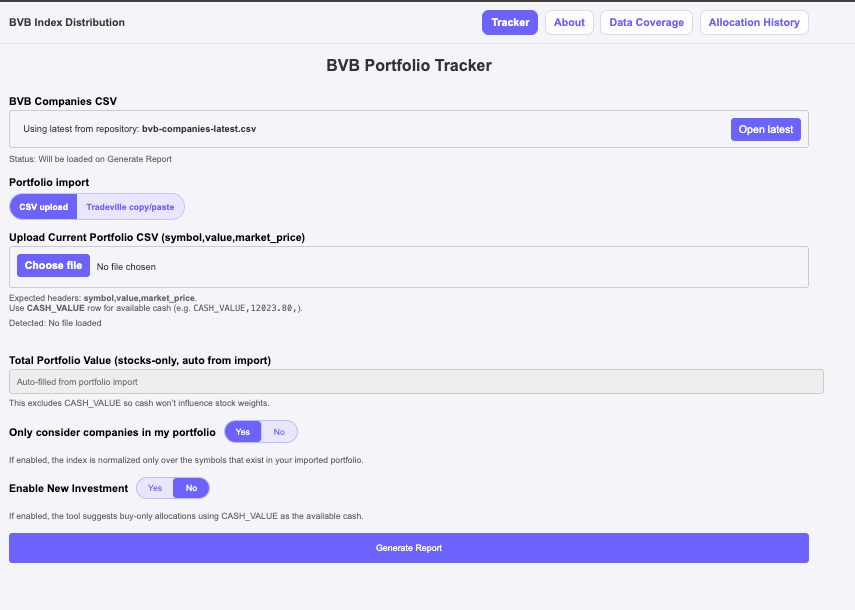
The main page (index.html) does most of the work.
It allows:
- importing a portfolio via CSV upload
- importing the same data via copy/paste from TradeVille (the platform I use for BVB investing; this part is intentionally tailored rather than fully generic)
- comparing portfolio weights against normalized BET weights (useful when not all BET constituents are held)
- generating buy-only investment suggestions
- validating the result via a simulated “portfolio after applying suggestions”
The emphasis is on transparency: all intermediate numbers are visible. This makes it easy to sanity-check results and adjust the algorithm when something feels off.
Allocation History
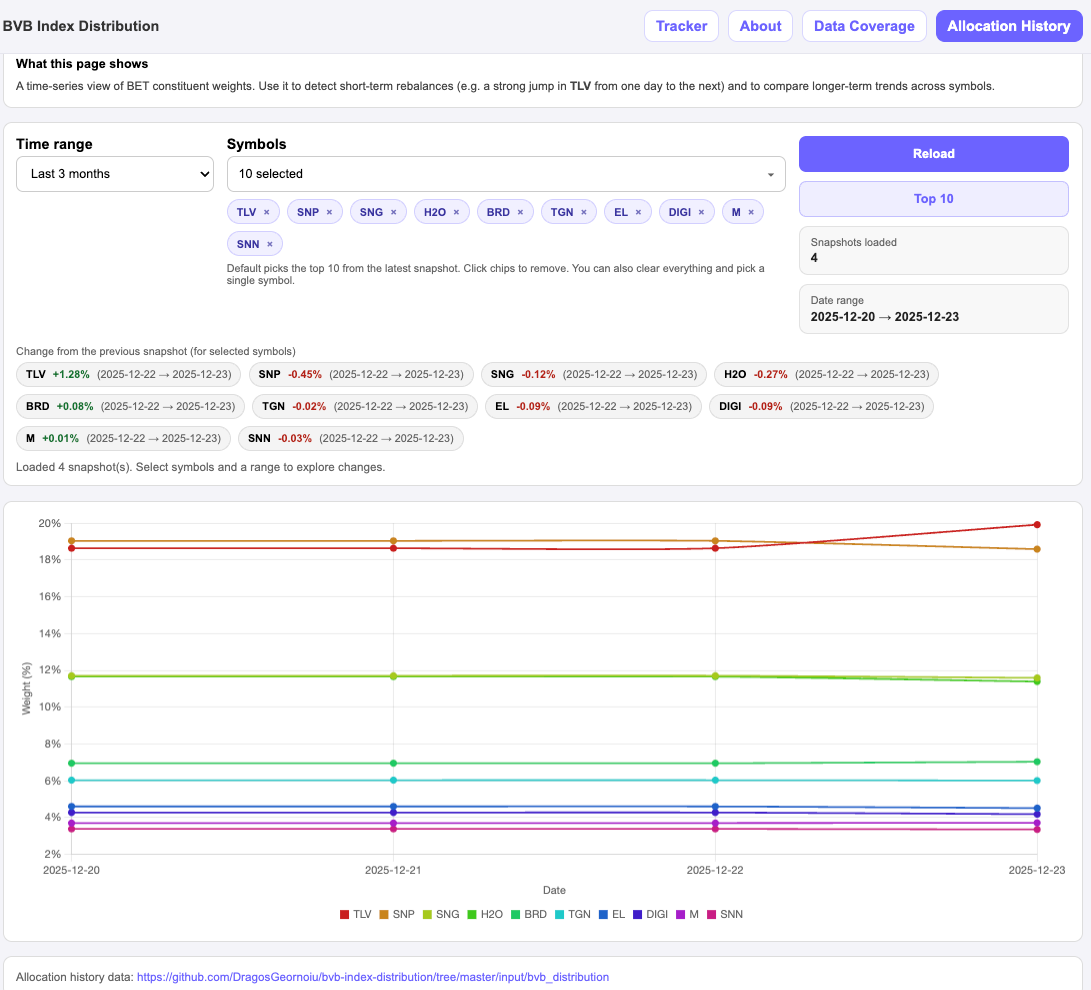
The Allocation History page was added once it became clear that understanding the index itself is just as important as tracking a portfolio against it.
This page:
- loads daily BET snapshots
- displays symbol weights as a time-series chart
- allows selecting symbols and time ranges
- highlights day-to-day changes
Seeing abrupt changes (for example, a sudden increase in TLV weight) provides useful context for why a portfolio might drift even without any trading activity.
Data Coverage
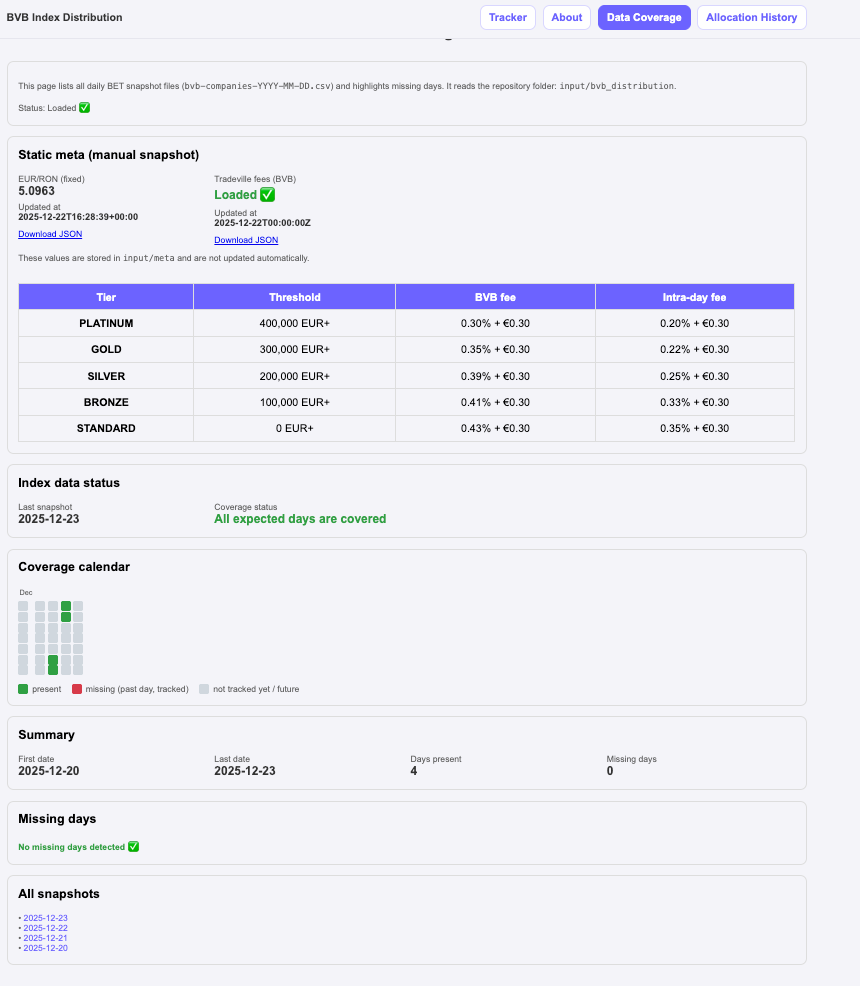
The Data Coverage page is intentionally boring.
It shows:
- which daily snapshots exist
- which days are missing
- direct links to each CSV file
Its main purpose is trust and debuggability. When results look unexpected, it is easy to verify exactly which data was used.
Portfolio input formats
CSV upload
The simplest input format is a CSV file:
symbol,value SNP,126506.66 TLV,122179.18 SNG,77051.70 H2O,75628.80 BRD,45400.00 CASH_VALUE,12023.80
The idea is straightforward:
- values represent current position value, not percentages
- CASH_VALUE represents available cash and is excluded from portfolio weights
The app does not enforce currency; it only assumes consistency.
TradeVille copy/paste
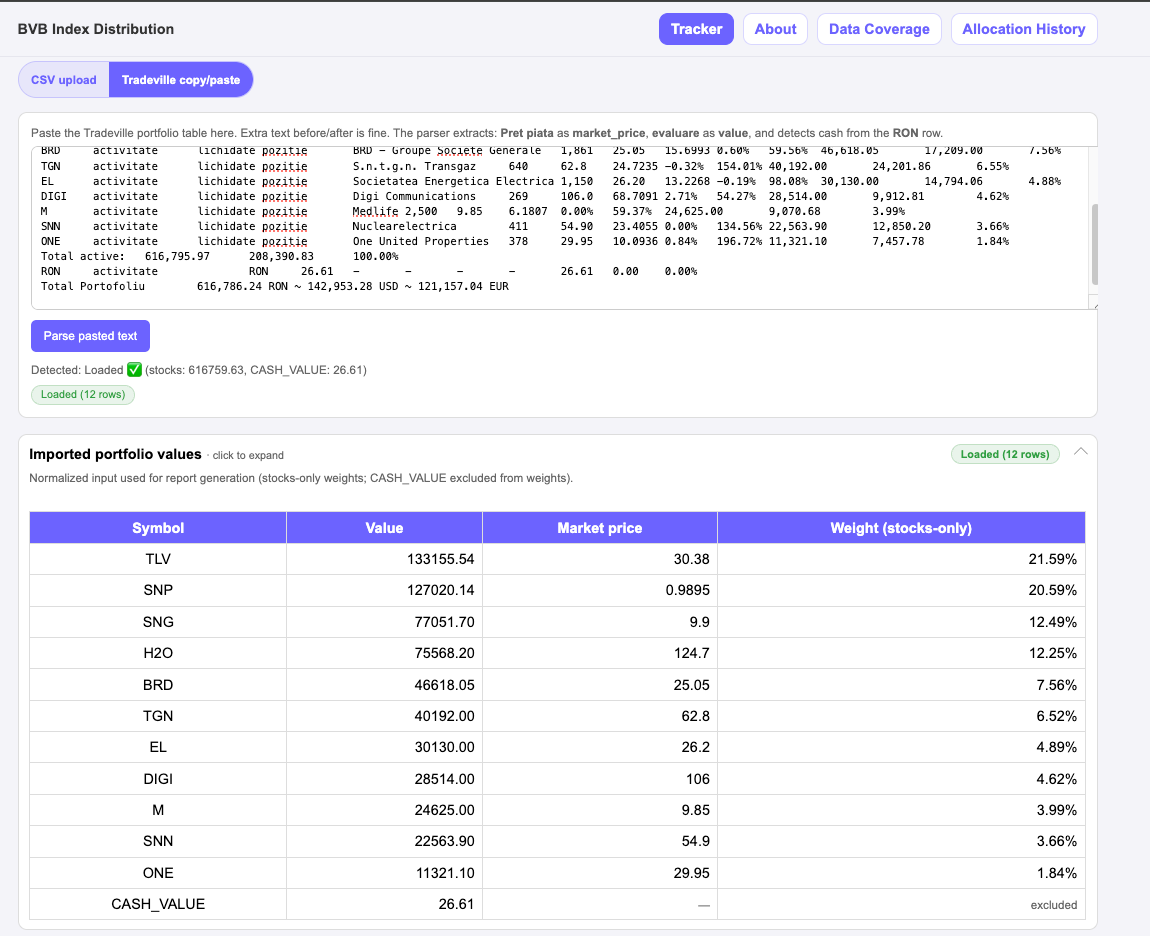
Because I personally use TradeVille, I added a tolerant copy/paste parser.
You can paste something like:
Instrumente BVB in RON simbol Nume sold Pret piata evaluare Pondere SNP OMV Petrom 128,368 0.9855 126,506.66 20.54% TLV Banca Transilvania 4,027 30.34 122,179.18 19.84% RON RON 12,023.80
The parser:
- ignores headers and extra text
- extracts symbol and evaluated value
- detects the RON row and maps it to CASH_VALUE
- ignores totals and summary rows
Internally, this is converted to the same structure as the CSV upload.
Index data and daily scraping
BET constituent weights are stored as daily CSV snapshots in the repository under:
input/bvb_distribution/
A GitHub Actions workflow runs once per day and performs the following steps:
- Fetches the BET composition from the source page.
- Parses the published table into a structured format.
- Writes a date-stamped CSV snapshot.
- Updates a separate “latest” snapshot for easy consumption by the app.
Because these snapshots are committed to the repository:
- the application never calls external services at runtime
- historical analysis is trivial
- index evolution can be visualized without additional infrastructure
This model trades freshness for simplicity and reproducibility, which is a trade-off I am comfortable with for a personal tool.
Buy-only suggestion algorithm
The investment suggestion logic is intentionally constrained and pragmatic.
Constraints
- buy-only (no selling)
- whole shares only
- total spend cannot exceed available cash
- minimum investment per symbol is enforced
- estimated broker fees are included (variable + fixed)
- prices are not rounded in the UI to avoid misleading calculations
Approach
The algorithm is primarily greedy:
- index weights are normalized to the chosen universe
- current portfolio weights are computed
- underweight symbols are identified
- cash is allocated iteratively to reduce overall tracking error
At each step, the algorithm evaluates which feasible purchase reduces deviation from the index the most, while still respecting real-world constraints such as fees and minimum order sizes.
This is not an optimization algorithm in the strict mathematical sense. It does not guarantee a globally optimal solution, and it does not attempt to solve a full knapsack or quadratic programming problem.
Instead, it aims for:
- reasonable index tracking
- predictable behavior
- easy inspection and adjustment
In practice, the results are “good enough” and align well with how incremental investing actually works.
Using AI as a force multiplier
A large part of this project was built with the help of AI.
I used it to:
- scaffold pages quickly
- iterate on UI structure
- explore alternative allocation strategies
- refactor logic while keeping behavior stable
However, it was not a hands-off process. Most iterations involved:
- reviewing generated code carefully
- adjusting constraints and edge cases
- validating output against real portfolio data
- refining UX and wording
AI significantly accelerated the process, but the intent, constraints, and final decisions remained manual.
Why I enjoyed this project
This project sits at a useful intersection of:
- investing
- data engineering
- frontend logic
- pragmatic product design
It is small enough to evolve freely, yet complex enough to surface real trade-offs between correctness, usability, and simplicity.
Most importantly, it solves a real problem I actually have. That alone made it worth building and iterating on.
Conclusion
Building this tool reinforced an idea I keep coming back to: small, focused, well-constrained systems can be surprisingly powerful.
A static site, some CSV files, and a bit of JavaScript were enough to build something genuinely useful, inspectable, and easy to maintain — without unnecessary complexity or infrastructure.